Cable reel sizes by flange
Cable reel sizes go by flange diameter, from 18-inch reels a person can carry to 96-inch reels that need a crane, and each size is written flange x traverse x drum in inches. Pick the flange page closest to what you have or need below; each one covers the traverse and drum combinations that turn up at that flange, what they hold and how many make a trailer load.
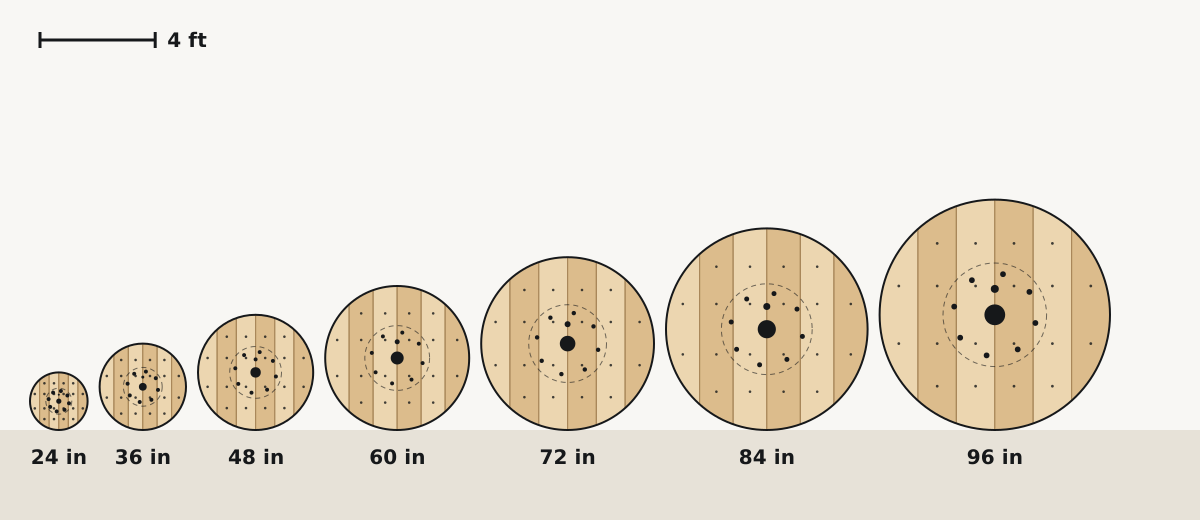
12 pages under cable reel sizes by flange
| Page | What it covers | Typical reel |
|---|---|---|
| 18-inch flange | 18 inch flange reels: the published 18x10x6 and 18x12x10 sizes, approximate footage by cable diameter, drum limits, weight and what to check used. | 18x10x6 |
| 24-inch flange | 24 inch flange cable reels: published 24x12x10, 24x18x10 and 24x16x12 sizes, plywood vs nailed builds, footage by cable OD and what a used 24 is worth. | 24x12x10 |
| 30-inch flange | 30 inch flange reels: the 30x18x12 four makers publish, Southwire's 30x22x16 and 30x23x17, approximate footage, weights of 21 to 66 lb and return rules. | 30x18x12 |
| 36-inch flange | 36 inch flange reels: 36x24x17 and other published sizes, 200 to a 53 ft van per Sonoco, approximate footage by cable OD, weights and stencil checks. | 36x24x17 |
| 42-inch flange | 42 inch flange wooden reels: 42x26x18, Southwire's A-29, C-22 and N-34, 120 to a 53 ft van, footage by cable OD, and why one size comes in two builds. | 42x26x18 |
| 48-inch flange | 48 inch flange reels: Southwire's 48x28x24 A-38, the 48x32x23 fiber reel, 100 to a 53 ft van, footage by cable OD and what cuts a used 48's value. | 48x28x24 |
| 54-inch flange | 54 inch flange cable reels: Okonite's 54x32x26 in 3,000 and 6,500 lb builds, 60 to a 53 ft van, footage at 3 in clearance and handling at 164 to 234 lb. | 54x32x26 |
| 60-inch flange | 60 inch flange wooden reels: Southwire's 60x28x28 A-62 at 397 lb, the 60x36x29.5 fiber reel, 39 to a 53 ft van, footage by cable OD, and wood vs steel. | 60x28x28 |
| 66-inch flange | 66 inch flange reels: 66x36x36 and 66x32x36 in two builds, Southwire's 66x28x30 A-76 and N-76, 24 per 53 ft van, footage and the 36 inch drum's limits. | 66x36x36 |
| 72-inch flange | 72 inch flange cable reels: 72x36x36, 72x42x36 and 72x48x36 builds from Okonite, Superior Essex fiber and copper reels, 22 per van and 41 to 56 in widths. | 72x36x36 |
| 84-inch flange | 84 inch flange wooden reels: the few published sizes (84x54x48, 84x42x42, 84x40x42), 9 to a 53 ft van, 639 to 920 lb empty, and the steel 84s to set aside. | 84x42x42 |
| 96-inch flange | 96 inch flange wooden reels: 96x48x48 and 96x54x56 at 758 to 1,199 lb, Superior Essex's 96x42x48, 8 to a 53 ft van, footage, deck heights and lifting. | 96x48x48 |
How a reel size is named
Three numbers, always in the same order. The first is the flange, the diameter of the two end discs. The second is the traverse, the clear width between the flanges where the cable winds. The third is the drum, the diameter of the barrel. A 54x32x26 is a 54-inch flange, 32 inches between flanges and a 26-inch drum. That convention is set by NEMA WC 26 / EEMAC 201, the US and Canadian standard for wire and cable packaging, and it is what Okonite stencils on its reels: flange x inside traverse x drum.
The chart is arranged by flange because flange is the number that sets handling and freight. It decides whether a reel rolls by hand or needs a forklift, how tall it stands on a flatbed and how many fit in a van. But the flange alone does not tell you capacity. Within one flange you will find reels with quite different drums and traverses, and their footage differs accordingly.
The chart at a glance
This table pulls one published example per flange from the cable makers' own reel tables, the NEMA-based footage Anixter prints for a reel at or near that flange, and Sonoco's count per 53-foot van where it lists one. Use it to see how the sizes step up. The individual flange pages go further.
| Flange | Example size and source | Anixter capacity for a reel at this flange | Reels per 53-ft van (Sonoco) |
|---|---|---|---|
| 18 in | 18x10x6, 11 lb (Okonite) | Not listed | Not listed |
| 24 in | 24x12x10, 23 lb (Okonite) | 24x12x10: 1,207 ft of 0.50 in cable | Not listed |
| 30 in | 30x18x12, 39 lb (Okonite) | 30x18x12: 2,509 ft of 0.50 in cable | Not listed |
| 36 in | 36x24x17, 77 lb (Okonite) | 36x24x16: 1,207 ft of 1.00 in cable | 200 of 36x24x17 |
| 42 in | 42x28x21, 154 lb (Southwire A-29) | 42x26x24: 1,478 ft of 1.00 in | 120 of 42x26x18 |
| 48 in | 48x28x24, 212 lb (Southwire A-38) | 48x36x24: 3,207 ft of 1.00 in | 100 of 48x28x24 |
| 54 in | 54x32x26, 164 or 234 lb (Okonite) | 54x32x24: 3,622 ft of 1.00 in | 60 of 54x32x36 |
| 60 in | 60x28x28, 397 lb (Southwire A-62) | 60x28x28: 3,910 ft of 1.00 in | 39 of 60x28x28 |
| 66 in | 66x36x36, 292 or 400 lb (Okonite) | 66x36x36: 5,433 ft of 1.00 in | 24 of 66x36x36 |
| 72 in | 72x36x36, 335 or 559 lb (Okonite) | 72x36x36: 7,215 ft of 1.00 in | 22 of 72x36x36 |
| 84 in | 84x42x42, 900 lb (Superior Essex) | 84x54x48: 13,370 ft of 1.00 in | 9 of 84x46x42 |
| 96 in | 96x42x48, 1,100 lb (Superior Essex) | 96x54x56: 17,558 ft of 1.00 in | 8 of 96x60x42 |
Anixter capacities use its clearances: 1 inch for flanges up to 28 inches, 2 inches for 30 to 48, 3 inches for 54 to 96. Sonoco's column labels are read here as flange x traverse x drum, matching the makers' tables.
Choosing a size, in four checks
- 01
Drum first
The drum has to meet the cable's bend limit. Anixter's table of NEMA multiples gives 10 times the outside diameter for nonshielded cable up to 2,000 volts, 14 for lead sheath and interlocked armor, 16 for wire armored and 20 for fiber, with a 12-inch floor for fiber.
- 02
Footage next
Run the capacity formula on reels with a suitable drum and find the flange and traverse that hold your length with clearance.
- 03
Weight
Check the cable weight against what the reel is rated for. Okonite rates a 36x24x17 for 2,000 pounds of cable and a heavy-build 72x36x36 for 8,000.
- 04
Fit and freight
Out-to-out and arbor hole must suit your stand or trailer. Then the smallest size that passes is usually the cheapest to move.
Why one flange holds many sizes
Cable plants order reels to suit their product, so a single flange comes in several shapes. Okonite's table alone lists 72-inch reels as 72x36x36, 72x36x40, 72x42x36 and 72x48x36, several of them in a lighter and a heavier build. Southwire's 66-inch reels include a 66x28x30. Superior Essex ships fiber on a 72x36x37.5.
For a buyer that is good news: if you need a 72-inch reel, there is a fair chance one of the common variants suits you. For a seller it means we need all three numbers, not just the flange, to place your reels. A lot written up as 20 pcs 72-inch reels could be any of five quite different things.
Small, mid and large: where the trade sits
Below about 30 inches, reels are light and cheap to make, many are plywood, and freight per reel is the main cost unless they move in big numbers. From 30 to 48 inches is the busiest part of the used trade: nailed wood reels that carry building wire feeders, fiber, rope and re-spooled cable, light enough to handle with a pallet jack or small forklift and still around 100 to 200 per van. From 54 to 72 inches, reels carry power cable and wire rope and need a forklift; counts per van drop to a few dozen. At 84 and 96 inches, every reel is a handling job, and the 8 or 9 that fit a van carry most of the price in freight.
Our chart runs from 18 to 96 inches because that covers most of what comes up for sale. Ely Reel builds nailed wood reels from 14 to 120 inches and Sonoco from 14 to 116, so larger and smaller exist; ask if you need one.
What the size line leaves out
Three numbers do not describe a whole reel. Arbor hole diameter decides which shafts fit; Southwire's wooden reels use 3.125 inches and Okonite's common reusable reels 3 inches, while small plywood spools drop to 2 or 1 1/2. Overall width decides which stands and trailers take it. Build decides strength: Okonite's table shows a 54x32x26 at 164 pounds rated for 3,000 pounds of cable and another at 234 pounds rated for 6,500, and its stencils name a class, Class 1 for standard duty and Class 2 for heavy duty.
So when you ask for a size, add anything that matters to your equipment. When you sell, add the arbor size and whether any reels carry steel hubs or plates. Our lot sheets record all of it next to the three numbers.
Sizes we are asked to convert
Some reels arrive from overseas plants marked in millimeters. Divide by 25.4 for inches: a 1,250 mm flange is about 49 inches, a 630 mm drum about 25. Others are written in a different order, or with two numbers instead of three. When in doubt, measure the reel yourself with the method in our measuring guide; it takes a tape and a few minutes.
Questions people ask
What do the three numbers on a reel mean?
Flange diameter, inside traverse and drum diameter, in inches, in that order. A 48x28x24 has a 48-inch flange, 28 inches between flanges and a 24-inch drum.
What is the most common cable reel size?
There is no published ranking, but sizes such as 30x18x12, 36x24x17 and 72x36x36 recur across several makers' tables.
How do I know which size I need?
Work from the cable: drum for its bend limit, flange and traverse for its length, reel build for its weight, then check the fit on your equipment.
Do you have reels bigger than 96 inches?
Rarely. Larger reels exist, up to 120-inch flanges from Ely Reel, but few come up used. Ask with the size and we will look.
Where these facts come from
- NEMA WC 26-2008 at ANSI webstore
- Anixter Wire and Cable Technical Information Handbook, Tables 10.1 and 10.2
- Okonite Technical News 33: reel dimensions and capacity
- Southwire reel packaging information
- Superior Essex TG110 OSP fiber wood reels (archived)
- Sonoco EcoReel packing guide (archived)
- Ely Reel products