Grading a used cable reel
A used wooden cable reel is graded on four things, in this order: the arbor hole, the flanges, the drum staves and the drive and tie-off holes. A reel with a sound arbor and whole flanges can carry cable again even with weathered wood or a few loose staves; a split arbor hole or a flange cracked through to the center ends its working life.
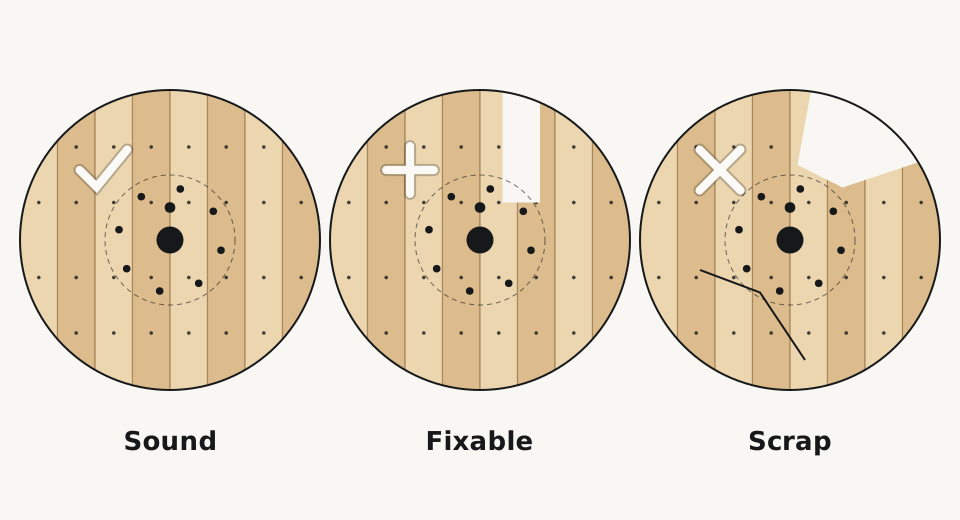
Why condition sets the price
Two reels with the same stencil can be worth very different amounts. One will take another load of cable on a payoff stand; the other is only good for something light, or for its wood. A buyer pays for the next trip the reel can make, and a seller is paid for the same thing. That is why we grade every reel lot and write the grade on the lot sheet next to the size and count.
Size and freight still matter as much as condition. A first-rate 96-inch reel costs a lot to move, and only a handful fit in a van, so its value depends on a buyer being close enough. A tidy lot of 36-inch reels moves easily because Sonoco's packing guide fits 200 of them in a 53-foot van.
The arbor hole comes first
Everything heavy that happens to a reel happens through the arbor hole: lifting on a shaft, turning on a stand, riding a reel trailer. Check it before anything else.
Look for a round hole of the expected size, usually about 3 inches on wooden reels. A hole worn oval has been turned on a shaft that was too small or run with the reel out of true. A crack running out from the hole is worse; it means the flange has started to split along its plies. On heavier reels look at the steel plate or hub round the hole: flat, tight, every bolt or nail in place. A split arbor hole doesn't carry cable. Service Wire's own reel return refuses reels without an undamaged arbor hole, which is a fair summary of how the trade sees it.
Flanges: cracks, plies and rot
Flanges take two kinds of damage. Impact damage comes from being dropped off a truck or hit by a forklift: a chunk out of the rim, a crack running in from the edge, a board knocked loose. Weather damage comes from standing outside on bare ground: soft wood at the lowest point, plies separating along the rim, mold or moss on the faces.
Short rim chips are cosmetic. A crack that runs from the rim toward the center is not, and one that reaches the arbor hole is a reject. Press the bottom edge of each flange with a thumb or a screwdriver; if the wood gives, the reel has been standing in water. Sight along the rim to check the flange is flat and square to the drum. A flange that leans out will lean further with cable on it.
Staves: count them
Walk around the drum and count missing, broken and loose staves. A 48x36x24 with two loose staves still carries cable; a nail or two puts them right. Missing staves leave a gap that the first wraps of cable fall into, and broken ones leave a sharp edge. Service Wire's return sets its bar at 75 percent of stave boards intact, which gives a sense of where one maker draws the line for reuse.
On reels meant for fiber, rope or anything with a soft jacket, check that stave ends sit flush with each other and no staples or nail heads stand proud. Anixter's handbook notes that staples used on reels must be shorter than the flange is thick, for the same reason: nothing should reach the cable.
Drive holes, tie-off holes and hardware
Drive holes take the pin of a powered stand or reel trailer. A drive hole torn out into a slot, or broken through to the rim, lowers a reel's value because it can no longer be driven without slipping. Reels that will only ever be turned by hand, or used for storage, care less.
Tie-off holes are small and tear easily. A torn one is a quick repair with a drill and some care, so we count them but do not treat them as serious. Through-bolts should all be present and tight; Corning's fiber procedure points out that humidity and temperature changes loosen wooden reel bolts, so tightening them is part of preparing any used reel.
Our grades
We use plain grades so buyers and sellers read the same thing. They describe the reel's next trip, not its looks.
| Grade | Arbor hole | Flanges | Staves | Holes and hardware | Good for |
|---|---|---|---|---|---|
| A | Round, no cracks, plate tight | Flat, square, no through-cracks, dry | All present and tight | Drive and tie-off holes sound, bolts tight | Any cable within the reel's rating, including heavy power cable |
| B | Sound, slight wear | Chips or surface weathering, no through-cracks | One or two loose, none missing | Minor tears in tie-off holes | Most cable, fiber, re-spooling, steel rope with care |
| C | Sound but worn | Weathered, small edge cracks | A few missing or loose | Drive holes worn | Light cable, rope, storage, short moves |
| Reject | Split, cracked or badly oval | Cracked through, rotten, delaminated | Many missing | Bolts missing, plate loose | Not for winding; parts or wood only |
Grades are our own shorthand for quoting. Makers and return programs use their own criteria.
What used reels fetch, and what the makers do with them
Prices for used reels are rarely published. One that is: AAA-Affordable Pallets of Tampa, Florida, lists what it pays for used wooden cable reels by size, from $3.00 for a 24x30 inch reel up to $10.00 for 48x28x24, 50x32x24 and 54x32x24 reels. That is one regional buyer's yard price and shows the low end of the market. It is not our price list.
At the other end, reels in Class 1 standard-duty or Class 2 heavy-duty condition that go back to a reel maker can be refurbished to the level of new reels and sold back to cable plants at the price of new, Okonite explains. Sonoco says most reels in its EcoReel program can be recycled three or more times, and its guide asks for flanges of at least 30 inches and at least 1.5 inches thick. Between scrap value and refurbished-as-new is where a graded used reel sits.
Checking a lot quickly
Done in this order, even a large lot goes quickly. If you send us the photos and the write-up, our grade and yours should match, and the price conversation is short.
- Stand the reels on their flanges in rows so every arbor hole is visible.
- Look through each arbor hole and at the plate; set aside any split ones first.
- Press the bottom rim of each flange for soft wood.
- Walk round the drum of one reel per row and count staves.
- Photograph the worst reel and one typical reel of each size.
- Write it up: size, count, grade, and anything unusual.
Questions people ask
What is the most important thing to check on a used cable reel?
The arbor hole. If it is split or badly worn, the reel cannot safely take a shaft, whatever the rest of it looks like.
Can a reel with missing staves be reused?
With one or two missing, often yes for lighter loads. Service Wire's return wants at least 75 percent of staves intact; for heavy cable we want them all present.
Does weathered wood make a reel worthless?
No. Grey, weathered faces are cosmetic. Soft or rotten wood at the bottom of the flanges is the problem.
How much is a used wooden cable reel worth?
It depends on size, grade, count and freight. One Florida buyer publishes $3 to $10 per reel at its yard; graded reels that can carry cable again are worth more to a buyer who needs them.