How many reels fit on a trailer
A 53-foot trailer holds anywhere from about 8 empty wooden reels with 96-inch flanges to about 200 with 36-inch flanges, according to Sonoco's reel packing guide. Empty reels fill a trailer by space long before they reach its weight limit, so flange size and how the reels are stacked decide the count, and the count decides the freight per reel.
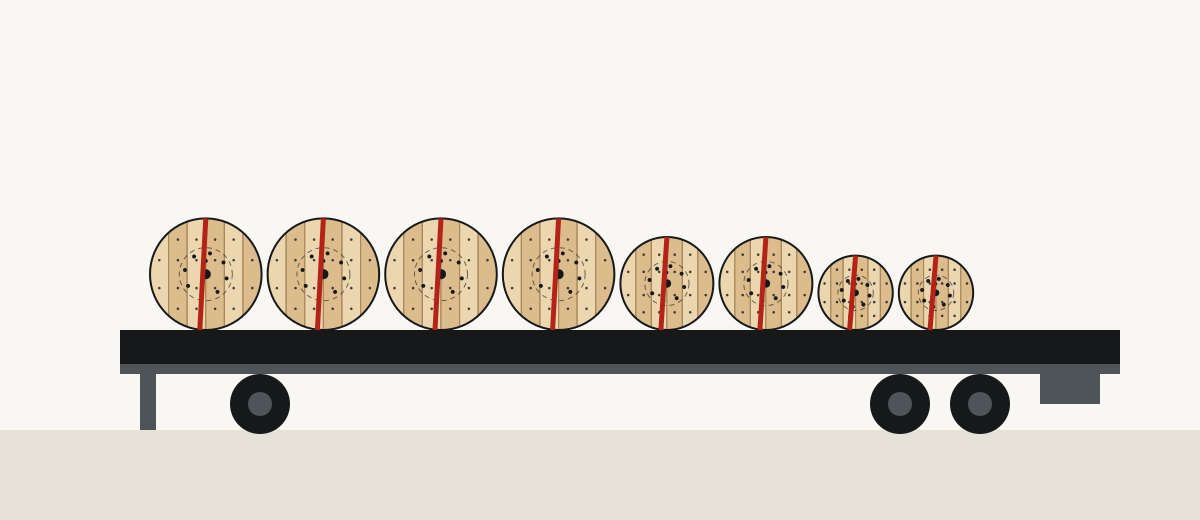
Sonoco's counts for a 53-foot van
Sonoco runs the EcoReel take-back program, which collects truckloads of used nailed wood and polyfiber reels, so it publishes how many reels of each size it expects in a 53-foot van. The table below reproduces those counts. Sonoco heads its columns flange, drum and traverse, but the figures match the flange x traverse x drum sizes in Okonite's and Southwire's reel tables (its 36, 24, 17 row is the common 36x24x17), so we show them in that order.
| Reel (F x T x D, inches) | Reels per van | Compared with 36-inch reels |
|---|---|---|
| 36x24x17 | 200 | 1 to 1 |
| 42x26x18 | 120 | 0.6 times as many |
| 48x28x24 | 100 | Half as many |
| 50x32x24 | 60 | 0.3 times |
| 54x32x36 | 60 | 0.3 times |
| 58x32x24 | 56 | 0.28 times |
| 60x28x28 | 39 | About a fifth |
| 66x36x36 | 24 | About an eighth |
| 72x36x36 | 22 | About a ninth |
| 84x46x42 | 9 | About 1 in 22 |
| 90x45x42 | 9 | About 1 in 22 |
| 96x60x42 | 8 | 1 in 25 |
Counts as published by Sonoco for its own pickups, with reels stacked to nest. Your count depends on condition, mix and who loads it.
Space runs out before weight does
Empty reels are mostly air. Multiply the counts above by published reel weights and the loads come out light. Two hundred 36x24x17 reels at Okonite's listed 77 pounds each are about 15,400 pounds. A hundred 48x28x24 reels at the 212 pounds Southwire lists for that size are about 21,200 pounds. Twenty-two 72x36x36 reels at Okonite's 335 to 559 pounds come to roughly 7,400 to 12,300 pounds.
All of those are well inside what a loaded 53-foot rig can carry under the federal 80,000-pound gross limit on interstates. So the trailer fills up by volume, and the only way to get more reels on is to stack them better. Wet reels weigh more, and a load of very heavy-build large reels should still be weighed, but for most empty lots the cube is the constraint.
| Reel | Count per van (Sonoco) | Weight per reel (source) | Load, approx. |
|---|---|---|---|
| 36x24x17 | 200 | 77 lb (Okonite) | 15,400 lb |
| 48x28x24 | 100 | 212 lb (Southwire A-38) | 21,200 lb |
| 72x36x36 | 22 | 335 to 559 lb (Okonite) | 7,370 to 12,298 lb |
Our arithmetic from the cited tables. Dry reels; moisture adds weight.
How reels are stacked to reach those counts
Sonoco's guide makes the key point: overlapping the flanges as the reels are stacked nests them and uses the full cubic volume of the trailer. Reels laid flat on a flange can be stacked so that each one above sits offset over the gap between two below, rather than square on top. Reels stood on their flanges in rows can be staggered so that the flanges of one row overlap the drums of the next. Either way, nesting is how a van takes far more reels than a square grid would allow.
Small and mid reels, up to about 48 inches, are usually laid flat and stacked. Large reels are usually stood on their flanges, chocked and strapped, because a big reel laid flat wastes height and is hard to lift off the stack. Mixed loads go big first: the largest reels at the nose of the trailer and the smaller ones filling the space behind and between.
Van or flatbed
A dry van keeps reels out of the weather and suits small and mid reels loaded by forklift at a dock. It needs reels that fit through the rear doors and can be pushed or carried to the nose. A flatbed takes reels too big or heavy for a van and lets a forklift load from the side, which matters at yards without a dock.
On a flatbed, height becomes a limit with the biggest reels. A 96-inch flange stood on edge on a standard flatbed deck about 5 feet off the ground reaches about 13 feet, close to the 13 feet 6 inches that most states allow without a permit. A step-deck or drop-deck trailer sits lower and gives more room. Width matters too: the federal limit for most trailers is 102 inches, so reels placed side by side must fit inside it, out-to-out.
- Dry van: weather protection, dock loading, small and mid reels, highest counts with stacking.
- Flatbed: side loading with a forklift, large reels stood on flanges, height to watch.
- Step-deck: lower deck for the tallest reels.
- Any trailer: chock both flanges and strap through the arbor or over the drum, not only across the rims.
What the count does to freight per reel
Freight is paid by the trailer. The truck costs much the same whether it carries 8 reels or 200, so each reel's share of the freight is the trip cost divided by the count. At 200 reels a van, a 36-inch reel carries one two-hundredth of the trip; at 8 reels, a 96-inch reel carries one eighth. That 25-fold difference is the single biggest reason large reels cost more per piece on both the buy and sell side.
It also explains why a part load is expensive. Forty small reels sent alone pay the whole trip between them. The same forty riding on a trailer already collecting another lot nearby pay a much smaller share. When we quote, we look for ways to fill the trailer: one seller's 36s with another's 48s, or a pickup on the way to a delivery.
Sizes that are not in the table
Most yards hold sizes Sonoco does not list, and plenty hold several. For an odd size, start from the nearest listed flange and adjust. A wider traverse than the listed reel means fewer per row when stood up, or taller stacks when laid flat; a reel with a 30-inch traverse takes more floor than a 24-inch one with the same flange. A heavier build with thick multi-ply flanges adds width that a tight row may not have.
Damaged reels load badly. A broken flange will not sit flush in a nested stack, and a reel with loose staves can collapse under the ones above it. Rejects are best kept off the trailer entirely, or loaded last on top where nothing presses down on them. That is one more reason to sort and grade a yard before the truck arrives rather than while the driver waits.
Planning a load from a yard
- 01
Sort by size
Group the reels by flange, traverse and drum. Mixed sizes are fine; we just need the count of each.
- 02
Check the counts
Compare each size with the table. A yard with 200 small reels or 20 large ones is already near a full van.
- 03
Note the access
Dock or no dock, forklift capacity, gate width, and whether a 53-foot trailer can turn in.
- 04
Stage them
Stand the reels on their flanges in rows near the loading point, worst ones set aside.
- 05
Send it in
Counts, sizes, photos and access notes to info@cablereelsforsale.com. We arrange the truck to suit.
Loading safely
Anixter's handbook gives the basics for handling reels: store and ship them standing on both flanges, except small ones under two feet and 200 pounds; never lift by the top flange; hoist with a shaft through both flanges. Corning adds that a forklift should never pick a reel up from its tail-flange side. Use forks long enough to reach under both flanges, or a spreader bar and shaft through the arbor for big reels. Keep people out of the roll path while a reel is moving.
Questions people ask
How many cable reels fit on a trailer?
Sonoco's packing guide gives about 200 reels of 36x24x17 in a 53-foot van, 100 of 48x28x24, 22 of 72x36x36 and 8 of 96x60x42, with reels stacked to nest.
Will a load of empty reels be overweight?
Rarely. Empty reels fill a trailer by space first. Published counts and reel weights put most full vans between about 7,000 and 22,000 pounds of reels.
Should reels go on a van or a flatbed?
Small and mid reels usually go in a van, stacked. Large reels and yards without a dock usually suit a flatbed, loaded from the side.
Why do big reels cost more to ship?
Only a few fit per trailer, so each one carries a bigger share of the trip cost. A 96-inch reel carries about 25 times the freight share of a 36-inch reel.