The parts of a cable reel
A wooden cable reel is two flanges joined by a drum of staves, with an arbor hole through the center for a shaft, plus drive holes, tie-off and start holes, bolts and markings. Each part has one job, and knowing which part does which job is how you judge a used reel, measure it and choose one for your cable.
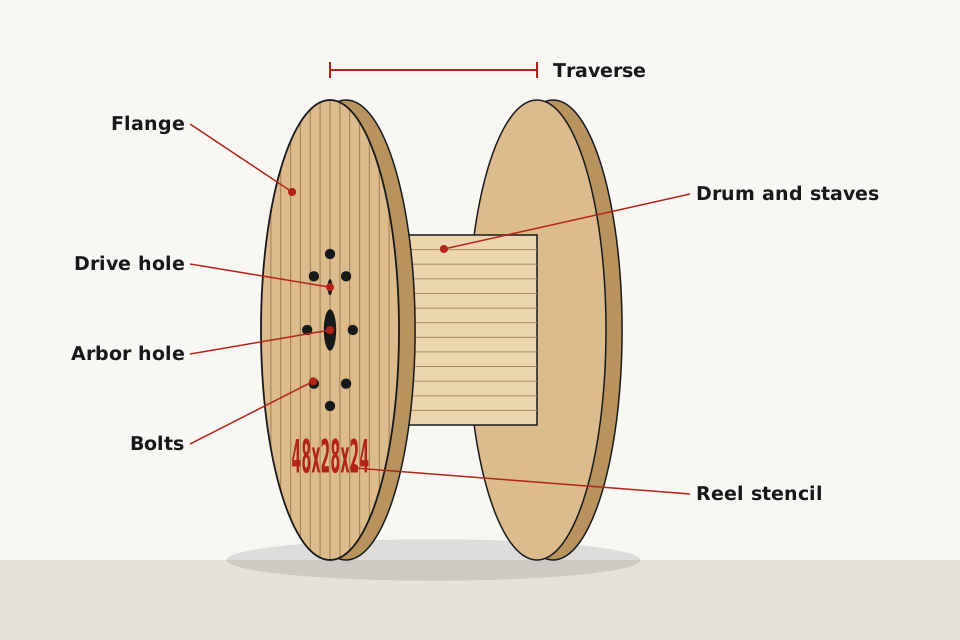
The parts at a glance
Kris-Tech Wire's description of a wooden wire reel lists the same pieces you will find on almost any nailed or plywood reel: flanges, a drum, the traverse between the flanges, an arbor hole for a shaft, start and tie-off holes, cable slots, and painted or stenciled markings. Add the hardware that holds it together and the lagging some reels carry when full, and you have the whole reel.
| Part | Where it is | What it does | What goes wrong |
|---|---|---|---|
| Flange | The two large discs at the ends | Holds the cable in; carries the reel when rolled or stood | Cracks from the rim, plies separating, rot at the bottom edge |
| Drum | The barrel between the flanges | The core the cable winds on | Staves missing, split or sunk |
| Stave | Lengthwise boards forming the drum | Make up the drum surface | Loose, broken or missing boards |
| Traverse | Inside width between flanges | Sets how wide the cable winds | Flanges leaning in or out change it |
| Arbor hole | Through the center of both flanges and drum | Takes the shaft for lifting, carrying and unwinding | Split, worn oval, plate loose |
| Arbor plate | Steel plate around the arbor hole, on some reels | Spreads shaft load into the flange | Fasteners missing, plate bent |
| Drive hole | Off-center hole in a flange | Takes a pin so a driver can turn the reel | Torn out to the rim or elongated |
| Tie-off hole | Small hole through the flange near the drum | Anchors the cable's inside end | Torn through; easy to repair |
| Start hole or cable slot | Near the drum in the flange | Lets the inner end exit for testing or connection | Rough edges that nick the jacket |
| Through-bolts | Running from flange to flange inside the drum | Clamp the flanges to the drum | Missing, loose or bent |
| Lagging | Slats around the full reel's outside | Protects the outer wraps in transit | Removed before reuse; leaves nail holes |
| Reel stencil | Painted or burned on a flange | Records size, maker and sometimes weight or job data | Faded by sun or painted over |
Flanges: plies, rims and the first number in the size
On a nailed wood reel each flange is built from layers of boards, called plies, laid across each other and nailed through. Southwire describes its all-wood reels as two-ply, with the layers nailed together at 90 degrees, for medium to heavy loads. The military reel spec MIL-DTL-12000 asks for two-ply flanges at right angles or three-ply flanges at 45 to 60 degrees to each other, with nails machine-driven in concentric circles. Ely Reel makes 2, 3 and 4-ply flanges in Southern Yellow Pine from 14 to 120 inches. On a plywood reel the flange is a disc cut from plywood sheet, lighter and thinner; Southwire uses plywood reels for light to medium loads, and Sonoco lists them from 10 to 60 inches.
The flange does two jobs that are easy to forget. It holds the cable in sideways against the pressure of tightly wound layers, and it is the wheel the reel rolls on and stands on. That second job is why flanges wear at the rim and rot at the lowest point when a reel stands on wet ground. When you check a used reel, look at the rim edge for separating plies, then look along the face for cracks running from the rim toward the center. A crack that reaches the arbor hole is a reject.
Flange diameter is the first number in the reel size. Flange thickness does not appear in the size at all, but it shows up in the out-to-out width, which is the traverse plus both flanges.
Drum and staves
The drum is a cylinder of staves, lengthwise boards set side by side around the flanges' inner circle and fastened at each end. Its diameter is the third number in the size. The drum takes the crushing load of every layer of cable wound on it, and its diameter sets the tightest bend the cable will ever see on that reel.
Staves are the first thing a buyer checks. A missing stave leaves a gap that the inner wraps sag into; a broken one can push a sharp end into the cable; a loose one rattles and lets the drum go out of round. A few loose staves on a big reel are not fatal. A 48x36x24 with two loose staves still carries cable. Service Wire's reel return sets its own line at at least 75 percent of stave boards intact, which gives a sense of where one maker draws it.
The arbor hole and the arbor plate
The arbor hole runs through the center of both flanges and the drum. A shaft, pipe or spindle goes through it so the reel can be lifted on a spreader, mounted on a stand, carried on a reel trailer or turned on a payoff. It is the single most important part of a used reel, because a reel that cannot take a shaft safely cannot be used for anything heavy. A split arbor hole doesn't carry cable.
Most wooden reels in the US have an arbor hole close to 3 inches. Southwire's nailed wood and plywood reels use 3.125 inches and its small G-series plywood spools 2 inches. Okonite lists 3 inches on its five most common reusable reels, from 30 to 58 inch flanges. Heavier reels add a steel plate or a pressed-in steel hub around the hole to spread the shaft load and stop the hole wearing oval. MIL-DTL-12000 requires a metal bushing or plate on wood and plywood reels with a gross weight of 2,500 pounds or more. On a used reel, check that the plate is flat and tight with every fastener, and measure the hole, because it decides which stands and shafts fit.
| Reel | Arbor hole | Source |
|---|---|---|
| Southwire nailed wood and plywood reels | 3.125 in | Southwire reel packaging information |
| Southwire G-series plywood spools | 2 in | Southwire |
| Okonite common reusable reels, 30 to 58 inch flanges | 3 in | Okonite Technical News 12 |
| Anixter small plywood reels, 12 to 16 inch | 1 1/2 in | Anixter handbook Table 10.3 |
| Anixter small plywood reels, 24 to 30 inch | 2 in | Anixter handbook Table 10.3 |
Drive holes, tie-off holes and slots
A drive hole is a hole in the flange, set out from the center, where a pin on a powered stand or reel trailer engages so the machine can turn the reel. If the reel will be driven, both the drive hole and the wood around it must be sound. Torn-out drive holes, stretched into a slot or broken through to the rim, lower a reel's value because it can no longer be turned by a driver without slipping.
The tie-off hole is smaller and sits close to the drum. The inside end of the cable is passed through it and tied off so the first wraps do not slip. Tie-off holes tear easily, and a torn one is one of the easiest repairs on a reel. Start holes and cable slots also sit near the drum and let the inner end leave the reel, which is how fiber crews test cable without unwinding it.
Bolts, nails and what holds it together
A nailed reel's flange plies are nailed to each other and the staves are fastened to the flanges. On most mid and large reels, steel through-bolts or tie rods also run from one flange to the other, inside the drum or just outside it, and clamp the whole assembly. They keep the flanges square to the drum when the reel is rolled, dropped or loaded heavily on one side.
On a used reel, count the bolts and check their nuts. A missing bolt lets that side of the flange flex. A bent one suggests the reel took a hard landing. Nail heads should be flush on the inner faces of the flanges, where the cable touches; a proud nail there will scrape a jacket.
Wood moves with the weather. Corning's fiber re-spooling procedure warns that changes in temperature and humidity can loosen the flange bolts on wooden reels, and tells crews to make sure every bolt is tight before loading. Anixter adds that any staples used on a reel must be shorter than the flange is thick, so they cannot reach the cable.
Lagging and the reel stencil
Lagging is a ring of wooden slats nailed around the rims of a full reel, closing off the outer wraps of cable. It is used for heavy or valuable cable and for long transport, and its presence tells you the reel left the plant heavy-duty. Lagging is removed before the cable is paid off, so empties rarely have it, but the nail holes round the rim edge remain.
The reel stencil is the painted or burned marking on a flange. Okonite lists what its reels carry: the cable supplier's name, the reel class, an arrow for rolling direction, the size as flange x inside traverse x drum, the reel maker and the date assembled. On reels with flanges under 40 inches, normally only the size, maker and date appear. Class 1 marks a standard-duty reel and Class 2 a heavy-duty one. The rolling arrow matters: roll the reel the way it points so the cable does not loosen. Faded stencils are common, and we measure regardless.
Out-to-out: the number not in the size
Out-to-out is the overall width of the reel, measured across the outer faces of both flanges. It is not part of the three-number size, yet it is often the number that decides whether a reel can be used. A payoff stand has a fixed gap between its uprights; a reel trailer has a fixed cradle; a flatbed has a legal width. If the out-to-out is too wide, the reel does not fit, however good it is.
To get it, add both flange thicknesses to the traverse, or simply measure across the outside. Include any arbor plates that stand proud of the flange face.
Handle the whole reel by its strong parts. Anixter's handbook says reels should be stored and shipped standing on both flanges, apart from small reels under two feet and 200 pounds, never lifted by the top flange, and hoisted with a shaft through both flanges.
Questions people ask
What is the flange of a cable reel?
One of the two large discs at the ends of the reel. Its diameter is the first number in the reel's size, and it holds the cable in and carries the reel when rolled.
What is the arbor hole on a reel?
The hole through the center of the flanges and drum where a shaft goes to lift, carry or unwind the reel. A split arbor hole makes a reel unsafe for heavy loads.
What are staves on a cable reel?
The lengthwise boards that form the drum. Missing or broken staves are the first thing a buyer checks.
What is lagging on a cable reel?
Wooden slats nailed around the outside of a full reel to protect the cable. It is removed before the cable is used, leaving nail holes at the rims.
What is the difference between traverse and out-to-out?
Traverse is the inside width between the flanges. Out-to-out is the overall width across the outside of both flanges.
What size is the arbor hole on a wooden cable reel?
Usually about 3 inches. Southwire's wooden reels use 3.125 inches and Okonite's common reusable reels 3 inches; small plywood spools often have 1 1/2 or 2 inch holes.
Where these facts come from
- Kris-Tech Wire: wooden reel anatomy
- Ely Reel products
- Sonoco wood reels
- Service Wire reel return
- Southwire reel packaging information
- Okonite Technical News 12: reels
- MIL-DTL-12000 reel requirements
- Anixter Wire and Cable Technical Information Handbook
- Corning SRP 005-051: cutting and respooling fiber cable